
FIFA World Cup 2026 Group F Schedule
Netherlands, Japan, Sweden and Tunisia meet from June 14 to June 25, with the group split across Texas, Monterrey and Kansas City.

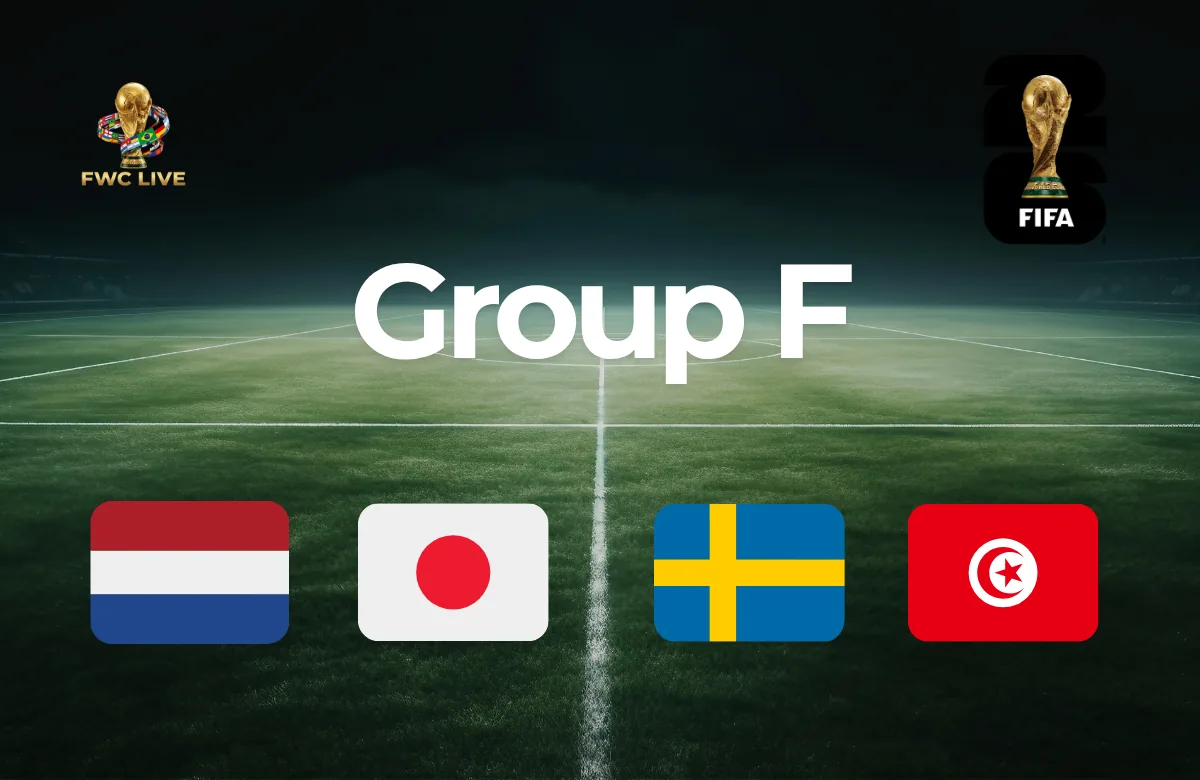
The FIFA World Cup 2026 Group F schedule begins on June 14 with Netherlands against Japan in Dallas and Sweden against Tunisia later that night in Monterrey. That opening pair gives the group a clear contrast between a classic European heavyweight test and a tense meeting between two sides built on defensive discipline. The fixtures then move through Arlington, Monterrey, Houston, Kansas City, and back to Arlington, so the section keeps a tight travel map across the southern corridor. In the larger FIFA World Cup 2026 draw, Group F looks balanced enough to stay live until the final whistle on June 25.
The Netherlands enters as the highest-profile team in the group, yet Japan arrives with one of the sharpest qualification runs in Asia. Sweden is back after winning through the UEFA play-offs, and Tunisia still carries a reputation for making tournament matches difficult. That blend gives Group F a favorite, but not much margin for comfort.
- Teams: 4
- Matches: 6
- Date Range: June 14-25
Group F Schedule Overview
| Date | Kickoff Time (ET) | Match | Venue | Round/Group |
|---|---|---|---|---|
| June 14, 2026 | 8 p.m. ET | Netherlands vs Japan | Dallas Stadium, Arlington | Group F |
| June 14, 2026 | 10 p.m. ET | Sweden vs Tunisia | Monterrey Stadium, Guadalupe | Group F |
| June 20, 2026 | 5 p.m. ET | Netherlands vs Sweden | Houston Stadium, Houston | Group F |
| June 21, 2026 | 12 a.m. ET | Tunisia vs Japan | Monterrey Stadium, Guadalupe | Group F |
| June 25, 2026 | 11 p.m. ET | Japan vs Sweden | Dallas Stadium, Arlington | Group F |
| June 25, 2026 | 11 p.m. ET | Tunisia vs Netherlands | Kansas City Stadium, Kansas City | Group F |
Pre-tournament standings — Group F opens in June 2026. All zeros represent the pre-tournament snapshot before any match is played.
Group F Teams at FIFA World Cup 2026
Group F has a clear seeded favorite, yet the rest of the section is packed with teams that know how to stay alive in tournament football. The Netherlands qualifies as one of Europe's strongest sides, Japan remains one of the most tactically stable teams in Asia, Sweden returns with renewed momentum, and Tunisia brings long-tested World Cup resilience. That should make the standings tighter than many first impressions suggest.
The schedule also creates pressure in the right places. Netherlands and Japan meet immediately, Sweden and Tunisia start with a direct race for early points, and the middle round then pits the Dutch against Sweden while Japan faces Tunisia in Monterrey. As a result, Group F could still be unresolved right up to the last simultaneous kickoffs.
Netherlands
The Netherlands national team enters Group F as the paper favorite and the side with the deepest tournament pedigree in the section. Ronald Koeman still has a squad shaped around Cody Gakpo, Virgil van Dijk, and a technically secure midfield core. The opener against Japan is already significant because it looks like the cleanest match for first place. If the Dutch win that game, they can take real control before facing Sweden and Tunisia.
Japan
The Japan national team arrives with one of the most consistent qualification records in world football and a squad that still looks tactically sharp under Hajime Moriyasu. Players such as Takefusa Kubo, Ritsu Doan, and Kaoru Mitoma give Japan enough technical pace to trouble every defense in the group. Starting against the Netherlands is difficult, yet it also gives Japan a chance to define the section early. If they stay close in Dallas, the later Tunisia and Sweden matches become very playable.
Sweden
The Sweden national team returns to the World Cup after beating Ukraine and Poland in the UEFA play-offs. Graham Potter now leads a squad with attacking quality through Alexander Isak and Viktor Gyokeres, yet the bigger strength may still be collective control and shape. The opening match against Tunisia matters because the Netherlands waits on matchday two. If Sweden starts cleanly, it can enter the middle round with a genuine path to the top two.
Tunisia
The Tunisia national team brings tournament experience, defensive discipline, and a habit of making higher-ranked sides work for every chance. Tunisia opens against Sweden in Monterrey and stays there to face Japan, which gives it a useful venue rhythm before the final match against the Netherlands. That continuity could help a side that prefers structure and patience. Tunisia may not be the headline team in Group F, but it is built to keep the group uncomfortable.
Group F Standings
| Team | MP | W | D | L | GD | Pts |
|---|---|---|---|---|---|---|
| 1. Netherlands | 0 | 0 | 0 | 0 | 0 | 0 |
| 2. Japan | 0 | 0 | 0 | 0 | 0 | 0 |
| 3. Sweden | 0 | 0 | 0 | 0 | 0 | 0 |
| 4. Tunisia | 0 | 0 | 0 | 0 | 0 | 0 |
Netherlands vs Japan — A 2010 World Cup Rematch
The Netherlands and Japan share a World Cup head-to-head that directly shapes Group F's expectation. At the 2010 FIFA World Cup in South Africa, the Netherlands defeated Japan 1–0 in the group stage, with Wesley Sneijder's goal separating the sides. The Dutch went on to reach the final that year. Japan have since developed into one of Asia's most consistent performers, and a rematch in 2026 would allow them to benchmark their growth against a side ranked in the top ten globally.
Sweden arrive having recently returned to major tournament football after their Euro 2024 absence. Tunisia are African regulars with disciplined defensive organization. The gap between the top and bottom of Group F is wide on paper, but the Netherlands are the only team that looks assured of a top-two finish from day one.
48-Team Format — How Third Place Qualification Works
The 2026 FIFA World Cup uses an expanded 48-team format for the first time. Forty-eight nations compete across 12 groups of four teams each. The top two finishers in every group advance automatically to the round of 32, accounting for 24 qualified teams. The remaining eight places go to the best third-place finishers across all 12 groups, ranked by points, goal difference, goals scored, and then FIFA fair-play criteria.
This means finishing third in Group F is not automatically an elimination. A team that collects four points — typically a win and a draw — with a positive goal difference has a strong chance of advancing as one of the eight best third-place sides. Teams finishing bottom of their group are eliminated regardless of points, since only one third-place team per group can advance.
The practical implication for Group F is that the race for second place carries more pressure than the race for first, while even a team in third is not out of contention until the last group matches are completed across all 12 sections.
Group F Qualification Prediction
Based on FIFA rankings, squad depth, home advantage factors, and head-to-head records, the following table shows the most likely qualification outcome from Group F. These predictions are pre-tournament estimates — a single result in any match can change the picture completely.
| Team | Predicted Finish | Qualification Route |
|---|---|---|
| Netherlands | 1st | Automatic qualification |
| Japan | 2nd | Automatic qualification |
| Sweden | 3rd | Best third-place contender |
| Tunisia | 4th | Elimination risk |
Key Dates and Venue Notes
June 14 is one of the cleanest opening days in the middle of the group stage calendar. Netherlands and Japan meet first in Arlington, then Sweden and Tunisia face off in Monterrey. That pairing should leave the section with an immediate shape because both matches carry real qualification value from the start.
June 20 and June 21 bring the tactical hinge of the group. The Netherlands plays Sweden in Houston, while Tunisia and Japan meet in Monterrey in a fixture that falls just after midnight in ET. If the opening results go to form, the Dutch could move into command there. If they do not, all four teams could still have a live route to qualification.
The final day is built for tension. Japan returns to Dallas to face Sweden, while Tunisia meets the Netherlands in Kansas City at the same ET kickoff time. That keeps the group fair and should make every permutation easy to follow across the last two hours.
How to Watch Group F Matches Live
The best live tracker for Group F is the FIFA World Cup 2026 match schedule, especially because one second-round match crosses into the next day on the ET clock. In the United States, FOX and FS1 carry the main English-language coverage, while Telemundo handles Spanish-language broadcasts. For channel and streaming details before each Group F kickoff, use the official broadcast coverage.
Frequently Asked Questions
Which teams are in FIFA World Cup 2026 Group F?
Group F features Netherlands, Japan, Sweden, and Tunisia. Sweden took the final place after winning through the UEFA play-offs.
When does the FIFA World Cup 2026 Group F schedule start?
Group F starts on June 14, 2026 with Netherlands vs Japan in Arlington. The final two matches are on June 25, 2026.
Where is Netherlands vs Sweden in Group F?
Netherlands vs Sweden is scheduled for Houston Stadium on June 20, 2026. Kickoff is listed at 5 p.m. ET.
Why is Group F difficult to call after the Netherlands?
Japan, Sweden, and Tunisia all arrive with clear tactical identities and recent qualification momentum. That makes the race for the second spot highly competitive.
How does Sweden qualify for the knockout stage in Group F?
Sweden's most realistic route is through the third-place qualification mechanism. In the 48-team format, the eight best third-place finishers across all 12 groups advance to the round of 32. Sweden would need to beat Tunisia and accumulate enough points from the Netherlands and Japan games to finish with a goal difference that ranks among the top third-place sides globally.
Conclusion
Group F gives the Netherlands the clearest paper edge, yet Japan, Sweden, and Tunisia all have the tools to keep the standings compressed deep into the group stage. The opening day and the Monterrey middle-round fixture should be especially important.
That mix of control, structure, and narrow margins could make Group F one of the steadier but more deceptive groups to follow.