
FIFA World Cup 2026 Group J Schedule
Argentina, Algeria, Austria and Jordan play from June 16 to June 27, with Group J moving through Kansas City, the Bay Area and Dallas.

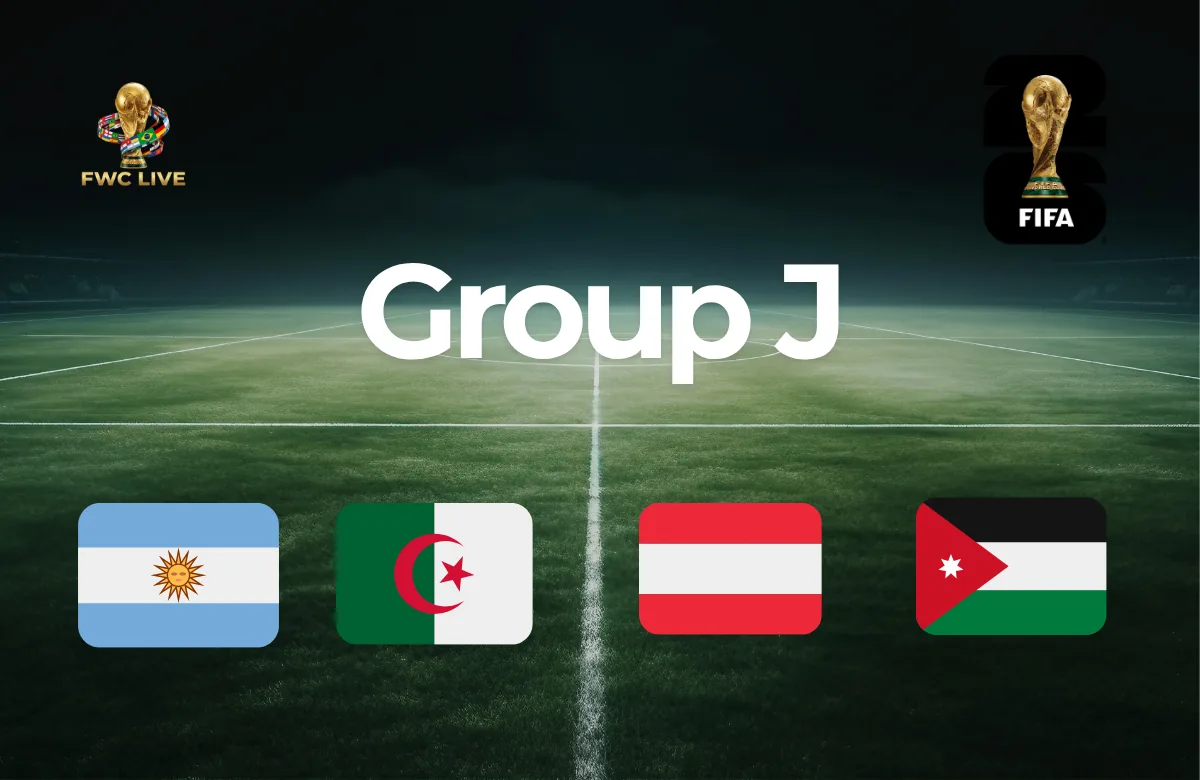
The FIFA World Cup 2026 Group J schedule starts on June 16 with Argentina meeting Algeria in Kansas City and Austria facing Jordan later the same night in the San Francisco Bay Area. That puts the reigning world champions straight into a section with three teams carrying very different qualification stories. The group then shifts to Dallas for Argentina's final two matches and closes with simultaneous fixtures on June 27. Inside the wider FIFA World Cup 2026 bracket, Group J looks strong at the top and volatile behind it.
Argentina enters as the defending champion and the highest-profile side in the group, while Austria returns after a 28-year gap and Jordan reaches the finals for the first time. Algeria also comes in with a strong qualifying run and an experienced core led by Riyad Mahrez. That mix gives Group J one obvious favorite, yet it also leaves the fight for second place open from the first night.
- Teams: 4
- Matches: 6
- Date Range: June 16-27
Group J Schedule Overview
| Date | Kickoff Time (ET) | Match | Venue | Round/Group |
|---|---|---|---|---|
| June 16, 2026 | 9 p.m. ET | Argentina vs Algeria | Kansas City Stadium, Kansas City | Group J |
| June 16, 2026 | 12 a.m. ET | Austria vs Jordan | San Francisco Bay Area Stadium, Santa Clara | Group J |
| June 22, 2026 | 1 p.m. ET | Argentina vs Austria | Dallas Stadium, Arlington | Group J |
| June 22, 2026 | 11 p.m. ET | Jordan vs Algeria | San Francisco Bay Area Stadium, Santa Clara | Group J |
| June 27, 2026 | 10 p.m. ET | Jordan vs Argentina | Dallas Stadium, Arlington | Group J |
| June 27, 2026 | 10 p.m. ET | Algeria vs Austria | Kansas City Stadium, Kansas City | Group J |
Pre-tournament standings — Group J opens in June 2026. All figures are pre-tournament and will update once matches begin.
Group J Teams at FIFA World Cup 2026
Group J brings together a reigning champion, a North African team with big-tournament ambition, an Austrian side back on the main stage, and a Jordan team writing a first World Cup chapter. Argentina has the deepest squad and the most recent elite tournament record. Austria and Algeria both arrive with enough structure to believe in a top-two finish, while Jordan has already shown it can break new ground in this phase.
The order of fixtures makes the group sharper. Argentina opens against Algeria, which gives the favorite a proper test instead of a soft start. Austria and Jordan then meet in a match that could set the tone for the whole second-place race. As a result, the middle round in Dallas and Santa Clara may decide whether the final day is tense or nearly settled.
Argentina
The Argentina national team arrives in Group J as the defending world champion and the side every rival will measure itself against. Lionel Scaloni still has a squad built on tactical control, deep midfield quality, and elite attacking options even as the phase evolves. The opening match against Algeria is important because it is probably the toughest first fixture available in the section. If Argentina handles that cleanly, the later games in Arlington should put qualification within reach.
Algeria
Algeria returns to the World Cup with a team that came through CAF qualifying in strong shape and still carries one of Africa's most recognizable leaders in Riyad Mahrez. The opener against Argentina is difficult, yet it also gives Algeria a chance to change the whole group on matchday one. The final-round meeting with Austria may prove decisive if the first two results keep the table compressed. Algeria looks well placed to challenge for second, especially if it stays disciplined without the ball.
Austria
The Austria national team is back at the World Cup for the first time since 1998 after topping its UEFA qualifying group. Ralf Rangnick has built a side that can press aggressively and play at high speed, which should make Austria uncomfortable for every opponent in the section. Starting against Jordan feels important because Argentina waits on the next matchday. If Austria wins the opener, the June 27 clash with Algeria could become a direct route into the round of 32.
Jordan
Jordan is one of the stories of the tournament because the 2026 finals mark the nation's first World Cup appearance. That breakthrough followed a strong qualifying run and a phase that has already produced major regional progress. The opener against Austria is the cleanest chance to collect an early result before matches with Algeria and Argentina. Jordan may be the outsider on paper, yet first-time qualifiers often become dangerous when the pressure is mostly on everyone else.
Group J Standings
| Team | MP | W | D | L | GD | Pts |
|---|---|---|---|---|---|---|
| 1. Argentina | 0 | 0 | 0 | 0 | 0 | 0 |
| 2. Algeria | 0 | 0 | 0 | 0 | 0 | 0 |
| 3. Austria | 0 | 0 | 0 | 0 | 0 | 0 |
| 4. Jordan | 0 | 0 | 0 | 0 | 0 | 0 |
Argentina vs Algeria — The Reigning Champions Versus Africa's Dark Horse
Group J's most interesting head-to-head angle sits between Argentina and Algeria. Argentina arrive as the reigning 2022 World Cup champions, ranked first in the world, with Lionel Messi in his final World Cup. Algeria produced a stunning AFCON-winning performance in 2019 and have developed a deep, experienced squad under consistent coaching. A competitive Group J meeting between the two would test Algeria's ability to contain a champion side with the tournament's greatest individual player.
Austria return to the World Cup after a significant absence and bring Bundesliga-level quality across their squad. Jordan qualify as Asia's representative and are the group's surprise inclusion. The ranking gap between Argentina and Jordan is one of the widest in the tournament, making early results against the group's mid-table sides critical for Algeria and Austria's second-place ambitions.
48-Team Format — How Third Place Qualification Works
The 2026 FIFA World Cup uses an expanded 48-team format for the first time. Forty-eight nations compete across 12 groups of four teams each. The top two finishers in every group advance automatically to the round of 32, accounting for 24 qualified teams. The remaining eight places go to the best third-place finishers across all 12 groups, ranked by points, goal difference, goals scored, and then FIFA fair-play criteria.
This means finishing third in Group J is not automatically an elimination. A team that collects four points — typically a win and a draw — with a positive goal difference has a strong chance of advancing as one of the eight best third-place sides. Teams finishing bottom of their group are eliminated regardless of points, since only one third-place team per group can advance.
The practical implication for Group J is that the race for second place carries more pressure than the race for first, while even a team in third is not out of contention until the last group matches are completed across all 12 sections.
Group J Qualification Prediction
Based on FIFA rankings, squad depth, home advantage factors, and head-to-head records, the following table shows the most likely qualification outcome from Group J. These predictions are pre-tournament estimates — a single result in any match can change the picture completely.
| Team | Predicted Finish | Qualification Route |
|---|---|---|
| Argentina | 1st | Automatic qualification |
| Algeria | 2nd | Automatic qualification |
| Austria | 3rd | Best third-place contender |
| Jordan | 4th | Elimination risk |
Key Dates and Venue Notes
June 16 is loaded with importance. Argentina meets Algeria in Kansas City in a fixture that should tell us quickly whether the defending champions will control the group from the start. Later that night, Austria and Jordan face off in Santa Clara in what already looks like a high-value match for the second-place race.
June 22 is the hinge point. Argentina takes on Austria in Arlington, and that game could decide whether the favorite moves clear on six points or stays under pressure. A few hours later, Jordan faces Algeria in Santa Clara, where the result may shape both qualification hopes and third-place positioning. If one of those two teams wins there, the final day becomes much clearer.
The final round on June 27 is set up cleanly with simultaneous late kickoffs. Jordan stays in Dallas to face Argentina, while Algeria returns to Kansas City for Austria. That split keeps the group fair and should leave no room for scoreboard watching in the closing stretch.
How to Watch Group J Matches Live
The best live tracker for Group J is the FIFA World Cup 2026 match schedule, especially because the group stretches across late ET kickoff windows and simultaneous final-day matches. In the United States, FOX and FS1 carry the main English-language coverage, while Telemundo handles Spanish-language broadcasts. For channel and streaming details before each Group J kickoff, use the official broadcast coverage.
Frequently Asked Questions
Which teams are in FIFA World Cup 2026 Group J?
Group J features Argentina, Algeria, Austria, and Jordan. Argentina is the seeded favorite in the section.
When does the FIFA World Cup 2026 Group J schedule start?
Group J starts on June 16, 2026 with Argentina vs Algeria and Austria vs Jordan. The final two group matches are on June 27, 2026.
Where is Argentina vs Austria in Group J?
Argentina vs Austria is scheduled for Dallas Stadium in Arlington on June 22, 2026. Kickoff is listed at 1 p.m. ET.
Why is Group J important for Jordan?
Jordan is making its first World Cup appearance, so every result in Group J is part of a historic debut. The opening match against Austria could shape the whole group.
Is this Lionel Messi's last World Cup in Group J?
Yes — Lionel Messi has confirmed that the 2026 FIFA World Cup will be his last, making every Argentina match in Group J a piece of footballing history. Messi arrives as the reigning World Cup winner after captaining Argentina to glory in Qatar 2022. Group J games against Algeria, Austria, and Jordan will draw enormous global audiences because fans know they are watching one of football's greatest players in his final tournament.
Conclusion
Group J gives Argentina the clearest edge, yet the section should stay competitive because Algeria and Austria both have credible paths to second place and Jordan arrives with first-time momentum. The opening night and the June 22 middle round look especially important.
That combination of title-defense pressure and a live second-place race should make Group J one of the stronger groups to follow outside the host-heavy sections.