
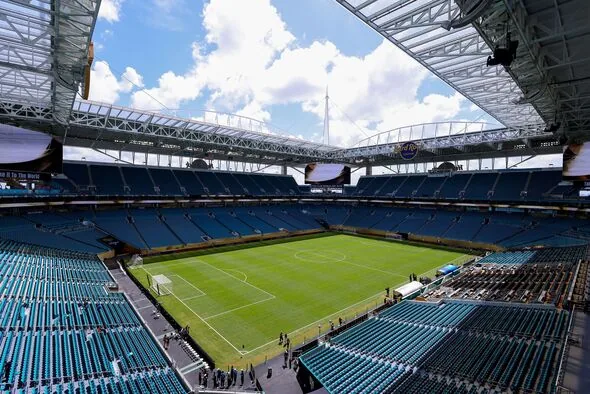
Miami will split its World Cup 2026 spotlight between Hard Rock Stadium in Miami Gardens and the fan festival at Bayfront Park. The host city is set for seven tournament matches, while downtown will carry the open-access festival side of the event. That combination makes Miami one of the clearest examples of how the tournament will stretch beyond the stadium gates. For supporters, the city guide is really about learning two matchday maps instead of one.
Why Miami matters on the 2026 map
Official FIFA scheduling gives Miami seven matches in total. The city will host four group-stage dates, then stay active with a Round of 32 match, a quarter-final, and the third-place game. That match load keeps Miami relevant from the opening weeks of the tournament into the final weekend. It also means demand will not fade after the early rounds the way it might in some other host cities.
Another important detail is the tournament naming. Hard Rock Stadium will appear as Miami Stadium for FIFA World Cup 2026, even though most fans already know it as the home of the Miami Dolphins. That matters for ticket holders, because stadium branding, transport messaging, and event instructions are likely to use the FIFA name rather than the NFL one. Readers can compare the venue basics in the Hard Rock Stadium and the wider World Cup schedule before locking travel plans.
What getting to Hard Rock Stadium looks like
The clearest travel message from the host-city guide is that driving remains the simplest route to the stadium. Parking in the lots is expected to start at $175, so convenience comes with a clear cost. For supporters staying in downtown Miami hotels, the trip to Miami Gardens is about 15 miles and can take roughly 45 minutes to an hour depending on traffic. That makes timing a bigger part of the plan than the raw distance might suggest.
Public transport is less settled. Shuttle service ran between Brightline Aventura Station and Hard Rock Stadium last year, but a 2026 plan has not been announced yet. That means supporters should treat rail-plus-shuttle travel as possible rather than confirmed for now. Until final event guidance is released, the safest assumption is that anyone without a car needs extra flexibility on arrival and exit.
Why Bayfront Park is central to the Miami experience
Miami is not only about the stadium bowl. FIFA has also confirmed a Miami Fan Festival at Bayfront Park, which gives the city a second focal point in the heart of downtown. No tickets are required for the festival, and the setup is designed around interactive fan experiences rather than only match attendance. That makes Bayfront Park the obvious destination for supporters who want the tournament atmosphere without entering the stadium every time.
The festival location is also straightforward. Bayfront Park sits at 301 Biscayne Blvd. in downtown Miami, and FIFA lists the opening days as June 13 through July 5. Because the site is along the waterfront and closer to major downtown movement, it changes how many fans may choose to base their trip. Some supporters will spend the stadium days in Miami Gardens and the off-days around Bayfront, which is why the broader World Cup host cities matters as much as the venue itself.
How fans should read the Miami guide
The main lesson is that Miami will operate as a two-zone World Cup city. Match attendance points north toward Miami Gardens, while the communal festival scene points downtown toward Bayfront Park. That split can create a better trip if supporters plan around it early, but it can also create avoidable stress if they assume everything sits in one compact district. Hotel choice, transport budget, and daily itinerary all change once that geography is understood properly.
Miami should still be one of the tournament's busiest and most attractive destinations. Yet the city guide shows that the best experience will come from realistic planning rather than from relying on the beach-city image alone. Hard Rock Stadium, Bayfront Park, and the official World Cup stadiums together make the real picture much clearer. For many fans, that clarity will be the difference between a smooth match week and an expensive scramble.
Frequently Asked Questions
How many World Cup 2026 matches will Miami host?
Miami is scheduled to host seven matches, including four group-stage dates, a Round of 32 tie, a quarter-final, and the third-place match.
Will Hard Rock Stadium use its normal name during the tournament?
No. FIFA tournament branding refers to Hard Rock Stadium as Miami Stadium.
How much does parking start at Hard Rock Stadium for the World Cup guide?
Official FIFA scheduling gives Miami seven matches in total. The city will host four group-stage dates, then stay active with a Round of 32 match, a quarter-final, and the third-place game.
Where is the Miami Fan Festival for World Cup 2026?
FIFA has listed Bayfront Park, 301 Biscayne Blvd., Miami, as the location for the Miami Fan Festival.
Do fans need tickets for Bayfront Park during World Cup 2026?
No. FIFA says no tickets are required for the Bayfront Park fan festival.
Miami's World Cup guide is really a guide to movement as much as football. The city will ask fans to think about stadium access, downtown festival time, and transport cost in the same trip plan.
That is why Miami stands out before the tournament even starts. It offers one of the clearest examples of a host city where the event experience extends far beyond the seat inside the stadium.
Keep tracking FWCLive.com for more verified <a href="/">FIFA World Cup 2026</a> host-city, venue, and fan-festival coverage.
Stay tuned to FWCLive.com for the latest FIFA World Cup 2026 updates.
Read Also: Philadelphia World Cup 2026 Fan-Friendly Plan Stands Out Before Kickoff